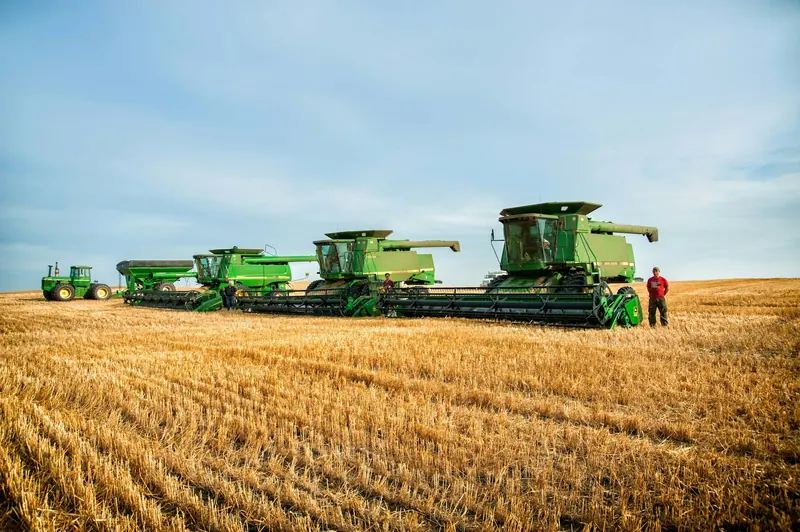
Kansas agriculture runs on a mix of year-round staff, family members, and extra hands at wheat harvest, calving, or fall feed season. That mix is exactly what makes a group health plan for a farm, ranch, feedlot, or grain elevator different from one for an office in Overland Park. The rules on who you must offer coverage to, how carriers count heads for participation, and which networks reach your town all turn on how your crew is built.
USDA counted 55,500 farms and ranches in Kansas in 2024, covering 44.8 million acres, with an average size of 807 acres. This page is for the ones with payroll.
Who works in Kansas agriculture
The Bureau of Labor Statistics Quarterly Census of Employment and Wages (QCEW) shows where the paid ag jobs sit in Kansas. For the 2025 annual average, private employers in the state reported:
- 13,579 jobs in agriculture, forestry, fishing and hunting across 1,952 establishments.
- 7,946 jobs in animal production, including 3,288 jobs at 146 beef cattle feedlots.
- 4,133 jobs in crop production.
- 3,669 jobs at 348 grain and field bean wholesalers, the industry category that includes country grain elevators and grain co-ops.
- 3,906 jobs at 295 farm and garden equipment wholesalers, where ag equipment dealers file.
Keep in mind that QCEW leaves out certain farm workers, the self-employed, and unpaid family members. The real farm workforce is larger than these counts. Feedlots and elevators tend to look like any other employer with steady hourly payroll. Row crop operations and custom harvesters swing hard with the season.
Full-time staff, seasonal hands, and the offer rule
Here is how it works in the small group market (2 to 50 employees). HealthCare.gov's SHOP rules say full-time employees generally work 30 or more hours per week, and the employer offers coverage to all of them. You do not have to offer coverage to part-time employees (those averaging under 30 hours) or to seasonal workers. You can choose to include part-time staff if you want to.
So a ranch with four year-round hands and six summer workers builds the plan around the four. The summer crew can stay off the plan without breaking the offer rule. Write that line into your eligibility terms clearly, with an hours threshold and a class description, so nobody argues about it in July.
Waiting periods still apply to the people you do cover. Federal rules cap a waiting period at 90 days, counted in calendar days. A new full-time hand hired in March can wait, but not past that limit. Our small business health insurance requirements page covers eligibility classes and waiting periods in more detail.
Family members on the farm payroll
Many Kansas operations pay a spouse, a son, or a daughter through payroll. That matters for whether you qualify as a group at all. Under HealthCare.gov's SHOP rules, a small employer needs at least one full-time equivalent employee who is not an owner, an owner's spouse, or a family member of an owner.
A farm where the only people on payroll are the owner, a spouse, and two adult children may not qualify for a small group plan on that test alone. Add one unrelated full-time hand, and the picture changes. Carriers check this at enrollment, so have payroll records ready that show who is related and who is not.
If a group plan does not fit, two other routes come up often for small family operations: an individual coverage HRA, or a QSEHRA for employers under 50 with no group plan. Both let the business reimburse individual policies instead. See ICHRA and QSEHRA in Kansas.
Participation math when your crew shrinks in winter
Carriers want enough of your eligible employees to enroll. HealthCare.gov's SHOP rules use a 70 percent participation standard for the employees you offer coverage to, and people who decline because they have other coverage do not count against you. On a farm, a hand covered through a spouse's job in town is a common waiver, and it does not hurt the count.
Seasonal workers you never offered coverage to stay out of the math. That is the payoff of a clean eligibility class. If you offer coverage to summer workers too, they join the denominator, and low enrollment among them can pull the whole group under the line.
If a group misses participation or contribution rules, federal rules let a carrier limit enrollment to a window that runs November 15 through December 15 each year, where state law allows. That window is a fallback, not the plan. It is better to set eligibility so the group meets the rules year round.
H-2A workers and health coverage
Some Kansas operations bring in H-2A workers for planting, harvest, and livestock work. Check the federal rules rather than assume. The H-2A program regulations at 20 CFR 655.122 list the benefits an employer must provide, including housing, transportation, meals or kitchen access, and workers compensation coverage. Health insurance is not on that list.
Workers compensation deserves its own note here. The Kansas workers compensation act does not apply to agricultural pursuits (K.S.A. 44-505), but H-2A rules require the employer to carry coverage equal to state workers compensation benefits when the job is exempt. That is injury coverage, not a health plan, and it never replaces one.
For the health plan itself, an H-2A worker is an employee like any other. Your plan's eligibility terms decide whether that person is offered coverage, so a seasonal H-2A position follows the same seasonal rule as any other seasonal hire. HealthCare.gov lists holders of worker visas such as H-2A among the immigration statuses that may qualify for Marketplace coverage, though starting in 2027 not for premium tax credits. That gives a worker a path to buy their own plan if your group plan does not include them.
Rural networks in rating areas 3, 4, and 5
Kansas has seven CMS rating areas, and the rating area for a small group plan follows the employer's principal business address. Much of farm and ranch country falls in three of them:
- Area 3, north central Kansas: Riley, Saline, Geary, Dickinson, Cloud, Republic, and eight more counties.
- Area 4, northwest Kansas: 25 counties, including Ellis, Barton, Thomas, Sherman, and Norton.
- Area 5, southwest Kansas: 21 counties, including Finney, Ford, Seward, Pratt, and Grant, the heart of feedlot country.
In the 2026 CMS rate filings, Blue Cross and Blue Shield of Kansas and UnitedHealthcare filed small group factors in all three areas. Medical Associates Health Plan is new for 2026 and filed in area 5 (and area 6 in south central Kansas) with HMO and POS plans. Blue KC files only in area 1, the Kansas City metro.
Carrier count is only half the question. Out here, the real test is whether the hospital in Garden City, Dodge City, Hays, or Great Bend and the clinic your crew actually uses sit in the plan's network. HMO plans tend to keep care inside a tighter network, while PPO plans pay for a wider set of providers. Check every name before you sign. Compare designs on our group health plan types page.
Ag equipment dealers, elevators, and co-ops
An ag equipment dealership in Salina, a grain co-op with elevators in five towns, or a feed yard near Liberal has steadier payroll than a family farm. These employers often cross the line between small and large group as they add locations. At 50 or more full-time employees, including full-time equivalents, the federal employer mandate applies. Past 50 eligible employees, the plan also moves from small group to large group rules.
Multi-site employers face one more wrinkle: employees who live in a different rating area than the main office. The rate follows the principal business address, but the network has to work where each person lives. A co-op based in Salina with branches in Hutchinson and western Kansas needs a network that reaches all of them.
Farm Bureau plans: an alternative outside the ACA market
Kansas law, at K.S.A. 40-2222, lets a nonprofit agricultural membership organization incorporated in Kansas on June 23, 1931 (the Kansas Farm Bureau, per legislative records) offer health benefit coverage to its members and their dependents. The statute says that coverage is not considered insurance. It sits outside the ACA small group market and outside the Insurance Commissioner's jurisdiction, apart from an annual actuarial filing.
Some farm families compare that option with a group plan. They work differently, so read the plan documents closely and weigh them side by side. A small group plan follows ACA rules on covered benefits and pre-existing conditions. The Farm Bureau coverage follows its own terms.
Next steps. List every person on payroll with hours, season, and family relationship. Then mark which ones are full time year round. That list tells you whether you qualify, who must be offered coverage, and how participation will land. Bring it to a quote request and we will price plans in your rating area and check your local doctors and hospitals against each network.
Sources
- USDA NASS, Kansas Farms and Land in Farms (released February 14, 2025)
- BLS QCEW, Kansas statewide annual averages 2025 (private ownership)
- BLS QCEW overview (coverage and exclusions)
- HealthCare.gov, How to qualify for SHOP
- 29 CFR 2590.715-2708, 90-day waiting period limit
- 45 CFR 147.104, guaranteed availability and the November 15 to December 15 window
- 45 CFR 147.102, small group rating area by principal business address
- 20 CFR 655.122, H-2A required benefits
- US DOL Wage and Hour Division, H-2A program
- HealthCare.gov, Immigration statuses that qualify for Marketplace coverage
- K.S.A. 44-505, Kansas workers compensation act application
- K.S.A. 40-2222, health coverage and Commissioner jurisdiction
- Kansas Legislature, SB 32 (2019) fiscal note on Farm Bureau health coverage
- CMS Kansas Geographic Rating Areas
- CMS Unified Rate Review Public Use File, plan year 2026